USA/UK/France | 101 min. | 2024 | French with English subtitles
Director: Max Keegan
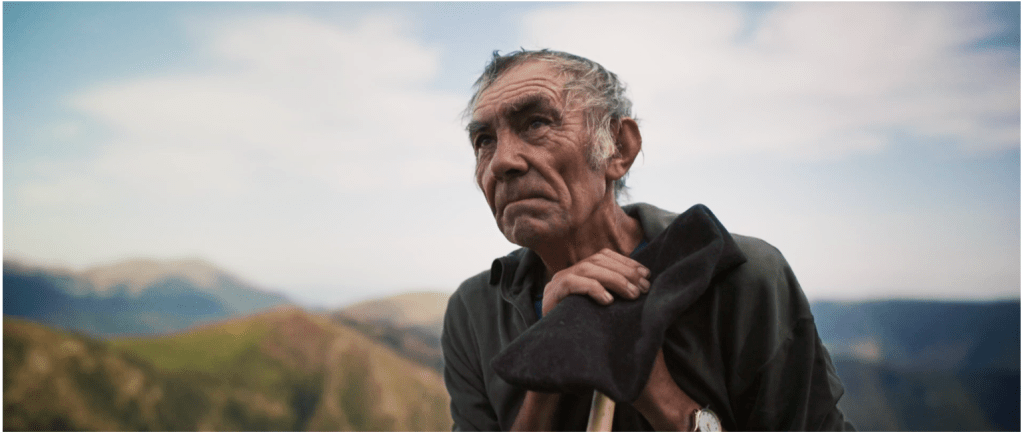
Set high in the majestic French Pyrenees, THE SHEPHERD AND THE BEAR explores a conflict provoked by the reintroduction of brown bears in the midst of a traditional shepherding community. The film follows an aging shepherd who struggles to find a successor as bears prey on his flock, and a teenage boy who becomes obsessed with tracking the bears. Through its breathtaking cinematography and immersive storytelling, THE SHEPHERD AND THE BEAR is a modern folktale about tradition, community and humanity’s relationship with a vanishing natural world.
Limited engagement – two days only. Get your tickets here.
Review by Sebastian Heiduschke
SHOOT THE BEAR?
One of the neat things about growing up in Europe was the proximity of countries to each other. When we drove from Germany to Switzerland every winter – a five-hour drive at most – we crossed through Austria in one hour and through Liechtenstein in about ten minutes, before we hit the mountains of Switzerland. In all of my years in the Alps, I never saw a bear.
After watching THE SHEPHERD AND THE BEAR, my curiosity took over. Were there any bears in the Alps? According to Wikipedia, yes, 98 individuals, give or take – ten more than in the French Pyreness, where the film is set. In 2004, the last brown bear, a female named Cannelle, was shot and killed by a hunter. Since then, the European Union started to reintroduce bears back to the region, to the delight of conservationists and adventure tourists, but much to the chagrin of local farmers whose life stock gets killed by the occasional bear attacks. This is the point where British film-maker Max Keagan inserted himself to document a conundrum.
This is Keagan’s first feature documentary, and he went all out. He learned French from scratch and spent two years living with the locals, a commitment that clearly paid off. Apparently, he took on such a heavy local accent that Parisians did not understand him, but the local population accepted him and his co-director of photography, Clément Beauvois, on the pastures and in gatherings. As we venture along the rolling green hills, watching seasoned shepherd Yves who spent more than fifty years in the mountains, we form a bond with him, with the animals, and with the nature surrounding him. We take delight in watching a big heard undulating up and down the alpine hills until they reach their grazing spot – only to be yanked from the pastoral idyl when more and more accidents happen.
Whose side should we take? Nature, represented by the bear, or that of the locals who have been grazing their sheep in that region for over 6,000 years, evidenced by cave paintings? Should we believe the researchers, activists, and wildlife experts shown in a documentary about bears that the villagers watch in Yves’ mountain cabin? When the program states that bears are “mostly vegetarian,” the locals can’t stop laughing.
And yet, it becomes clear that they don’t hate bears. Their intrinsic knowledge of nature allows them to accept the relationship between predator and prey. They have a hard time understanding why the government would drop off bears as we see in the opening shots of the film in an effort to repopulate the region with an endangered species. And yet, we are not forced to take a side in this discussion. We can enjoy the breathtaking scenery, and we should talk about the pros and cons, knowing that there is no completely right or wrong answer.
I am thankful that the film’s working title, SHOOT THE BEAR, was changed into something much more palatable and appropriate. This is the film you want to see on a big screen, and it seems appropriate to end with a quote by Keagan: “We shot this knowing we wanted it to be a cinematic experience. At several points in the edit we took it to a big screen to check that it was working in terms of timing at that scale as well. So we’re delighted that people will actually be able to see it like that.”